Free contractor invoice generator
Built for trades and on-site work — bill labor and materials, add sales tax, and download or print a professional invoice from any device.
| Description | Qty | Rate | Tax | Amount | |
|---|---|---|---|---|---|
| $0.00 |
| Subtotal | $0.00 |
| Total | $0.00 |
Email this invoice
Sends a PDF attachment to your client. Replies come back to you.
Save your invoice — for free
Create a free account (or log in) to keep billing without starting over.
New here? We’ll create your account automatically.
Your invoice is downloading
Check your downloads folder for 20260812_INV-0001.pdf. Thanks for using BillCrafter!
Sign this invoice
Draw your signature below. It’s embedded into the PDF and stored with a signing record.
My invoices
Click Save to store the current one.
The parts of an invoice, labelled.
A complete invoice has nine parts. The editor above has a field for every one — here's where each sits on the finished document.
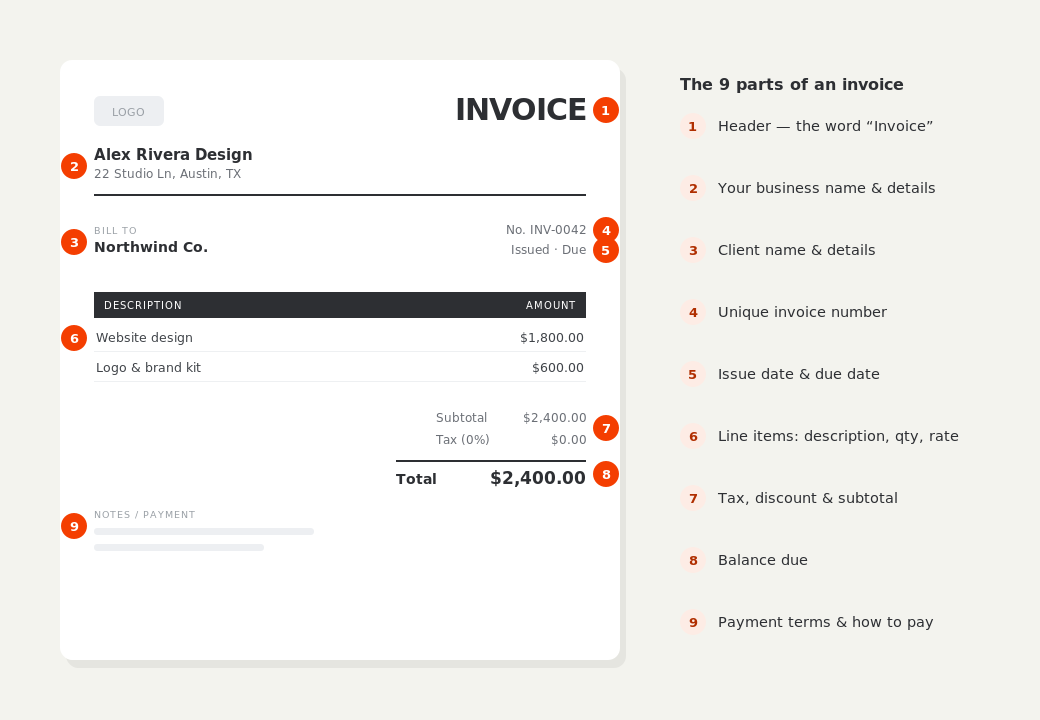
What to put on this invoice.
Miss one of these and the document usually comes back with a question attached. Everything here is a field in the editor above.
- The job address, not just the billing address
- Labor as hours × rate, listed separately
- Materials itemized, with quantities
- Which lines are taxable and which aren't
- Any deposit already paid, and the balance due
- Warranty or guarantee terms on the work
- Permit or job reference numbers where relevant
Keep labor and materials on separate lines
Combining them into one figure is the fastest way to get an invoice questioned. Listing “Interior painting — labor, 18 hrs @ $55” above “Paint and materials — $340” shows the client exactly what they're paying for, and it matters practically too: in many US states labor and materials are taxed differently, so they have to be separable anyway. It also makes change orders easy to add without rewriting the whole document.
Sales tax varies more than most trades expect
Whether you charge tax on labor, on materials, or on both depends on your state and sometimes on the type of work — new construction and repair are often treated differently. BillCrafter lets you mark each line taxable or not, so a materials line can carry tax while a labor line doesn't. What the correct treatment is for your work is a question for your state's revenue department or your accountant; this tool will apply whatever you tell it to.
Deposits, progress billing and the final invoice
Larger jobs rarely bill once. A common pattern is a deposit up front, one or two progress invoices at agreed milestones, and a final invoice on completion. Record what's already been paid in the “Amount paid” field and the document shows the remaining balance instead of the full contract value — which stops clients paying the same amount twice, and stops you chasing money you've already received.
Contractor invoice generator — common questions.
Should I charge sales tax on labor?
It depends on your state and the type of work — some tax labor, some tax only materials, and some distinguish repair from new construction. Mark each line taxable or not to match your situation, and confirm the rule with your state revenue office or accountant.
Can I invoice from the job site?
Yes. The editor works in a phone or tablet browser, so you can fill in the invoice before you leave, download the PDF and email it to the client while you're still there.
How do I show a deposit that's already been paid?
Enter it in the “Amount paid” field. The invoice then shows the total, the amount received, and the balance due — so the client pays the remainder, not the whole figure again.
BillCrafter is a document tool, not an accounting or legal service. Tax and contract rules vary by country and state — check anything material with a qualified professional.
What the official guidance says
“Your invoice must include a unique identification number, your company name, address and contact information [and] the total amount owed.”
— GOV.UK, “Invoices — what they must include”
Requirements differ by country, but the essentials are consistent: a unique invoice number, the seller and the buyer, an itemized description, the amount due, and clear payment terms. Every BillCrafter template is built around those fields. The primary sources we follow are below.
- GOV.UK — Invoicing and taking payment from customers — The UK government’s list of what every invoice must legally include.
- IRS — Recordkeeping for small business — US guidance on the invoices and receipts you should keep, and for how long.
- U.S. Small Business Administration — Manage your finances — Bookkeeping, accounts receivable and getting paid as a small business.
Other documents you can create free.
Make one now. Sign in to keep it.
Contractors, painters, electricians, plumbers and cleaners can invoice on the job site. Separate labor from materials, mark which lines are taxable, and hand the client a clear, itemized invoice.
1 · Make your first invoice free
Start typing on the document right now — no account, no card, nothing to install. Fill in your details and download a polished PDF in under two minutes. Your first export is on us.
2 · Sign in and it’s saved
A free account keeps your business details, clients and every past invoice in the cloud — so the next one takes seconds, from any device. Free accounts get 5 exports a month.
3 · Pick from 45 templates
Eight distinct layouts, twelve accent colors, and presets for freelance, contracting, consulting, photography and more — plus estimates, quotes and receipts. Browse the library.
Three steps to a paid invoice.
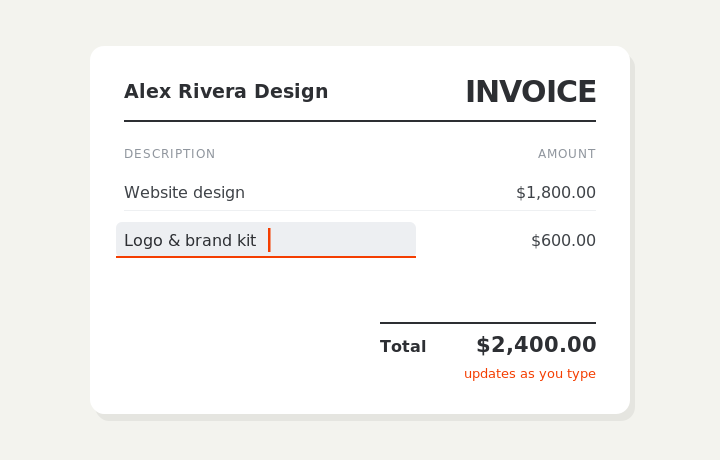
Type on the invoice
Fill in your business, client, and line items right on the document. Totals and tax calculate live as you type.
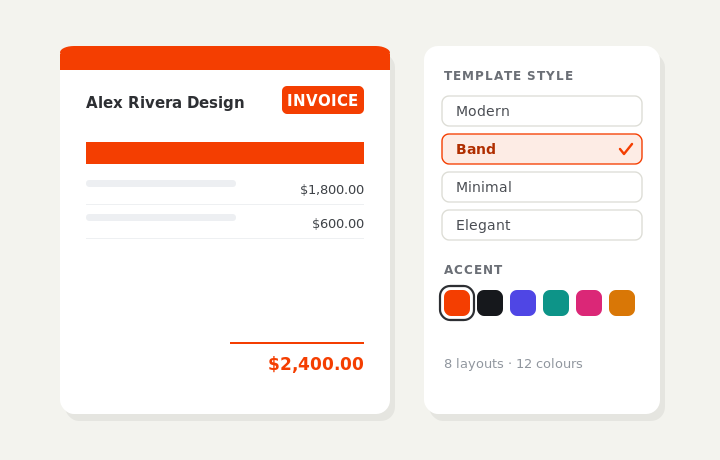
Customize & preview
Upload your logo, pick one of eight layouts and a color — the invoice you see is exactly what downloads.
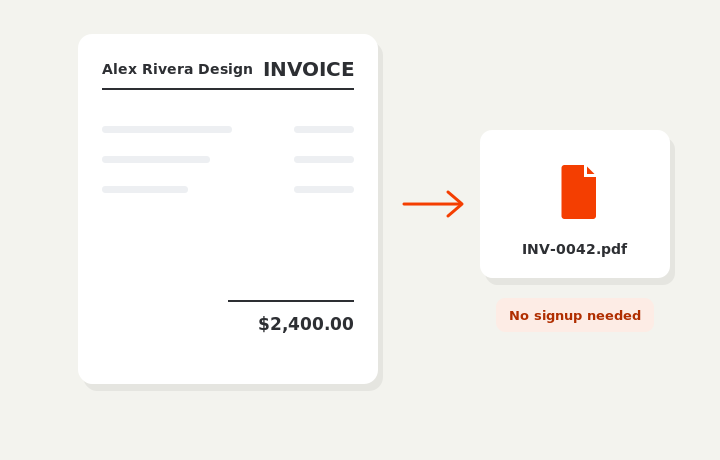
Download or send
Download a clean PDF, or sign in and email it straight to your client.